The book
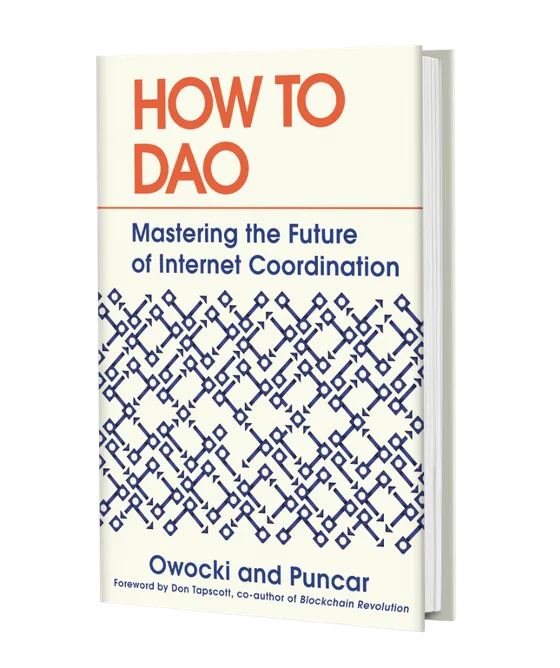
How to DAO: the book behind the practice
Co-authored by Kevin Owocki and Puncar, with a foreword by Don Tapscott. Published by Portfolio, an imprint of Penguin Random House, in 2025.
What the book is about
A field guide to internet-native coordination.
How to DAO examines how decentralized organizations actually work: how they distribute authority instead of concentrating it, share context instead of hoarding information, govern decisions in the open, and make execution transparent enough for strangers to contribute meaningfully.
Those mechanisms were forged in internet-native communities, but the underlying questions — who decides, who knows what, who is accountable — belong to every organization.
What the practice applies today
The same coordination problems, now with AI agents in the room.
As AI agents enter real workflows, the questions the book worked through move into every organization. How to DAO the consulting practice applies that published foundation to current operating-model work:
- Distributed governance
- Explicit decision rights for humans and agents
- Shared context
- Organizational memory both people and agents can use
- Transparent execution
- Oversight, auditability, and escalation paths
- Contributor coordination
- Human–agent workflow design
Companion resources
Material created around the book.
These companion resources were created around the 2025 book and its original audience. They remain available as published.
Quests
Hands-on companion exercises
Practical quests that accompanied the book's exploration of decentralized coordination.
Open Quests →DAO jobs
Work in the ecosystem
The companion jobs surface for roles across decentralized organizations.
Open DAO jobs →Gitcoin
Funding public goods
A companion page on Gitcoin's quadratic funding approach to coordinating resources.
Open Gitcoin →BanklessDAO
A community case
A companion page on BanklessDAO as an early large-scale coordination experiment.
Open BanklessDAO →A clear separation: the book was written by Kevin Owocki and Puncar, with a foreword by Don Tapscott, and published by Portfolio, an imprint of Penguin Random House. The How to DAO consulting practice is led by Puncar. The co-author, foreword author, and publisher are not part of the practice, and their work on the book is not an endorsement of How to DAO consulting.
Applying these ideas to an agentic organization?
The practice works with leadership teams on decision rights, oversight, and organizational context for work shared by humans and AI agents.