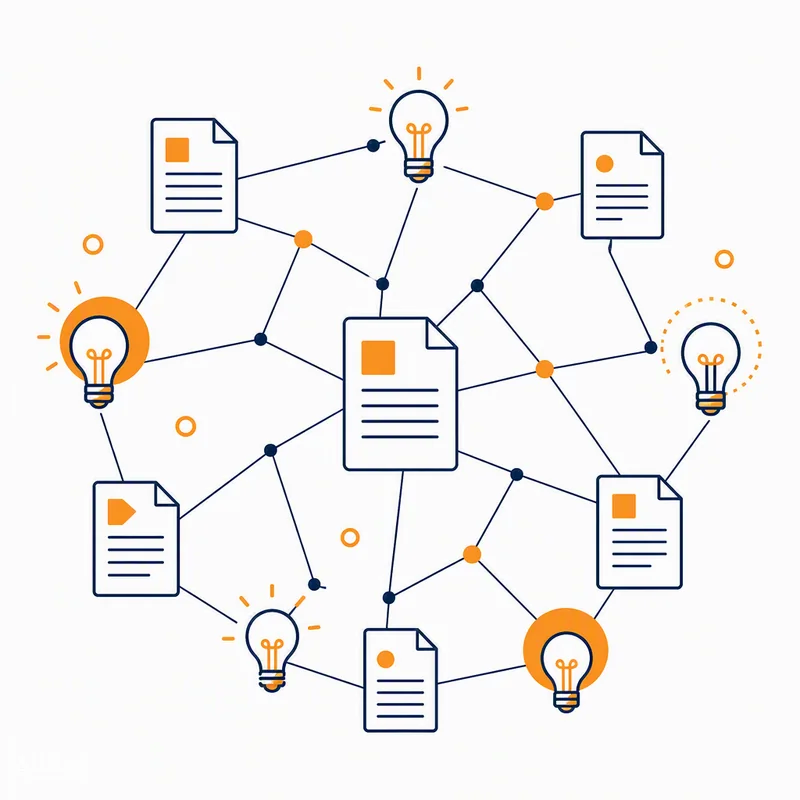
For most companies, AI transformation still means deploying copilots, writing prompt guidelines, and asking teams to work faster. Those things matter, but they leave the structure of the company mostly unchanged. The deeper question is organizational: what happens when agents can coordinate work, maintain context, execute repeatable processes, and surface decisions faster than a hierarchy of humans can route information?
Block and Coinbase are useful because they are not writing generic AI strategy. They are describing how the company itself changes. Their public materials point toward the same operating-model shift: smaller teams, fewer coordination layers, more directly responsible ownership, agents connected to production systems, and human judgment concentrated at the edge of the system.
Block: hierarchy as an information-routing problem
In "From Hierarchy to Intelligence," Jack Dorsey and Roelof Botha argue that hierarchy has always solved an information-flow constraint. Leaders could only process a small amount of context, so organizations added layers. Block's proposed alternative is not simply flatter management. It is a company built around a world model, an intelligence layer, and interfaces where people act with richer context.
The important move is that Block separates the coordination function from the manager role. The world model carries context. Directly Responsible Individuals own cross-cutting outcomes. Individual contributors build and operate the capabilities. Player-coaches develop craft and people while staying close to the work. The old middle-management routing function becomes less central because the system handles more of the alignment.
Goose: agents connected to real systems
Block's codename goose shows the infrastructure side of the same thesis. It is an open AI agent framework that connects language models to real-world actions and systems, including through the Model Context Protocol. The first use case is software engineering, where the agent can search, navigate, edit, run code, run tests, and refine work inside the development environment.
This matters because autonomous transformation does not happen in slide decks. It happens when agents can operate against the actual systems where work lives while staying inside governance, permissioning, and review boundaries.
Coinbase: AI-native as a management system
Brian Armstrong's May 5, 2026 Coinbase memo is explicit that AI is changing how the company operates. The memo describes a leaner organization with fewer layers, no pure managers, AI-native pods, and people who can manage fleets of agents. That is not a software adoption message. It is an operating-model message.
Coinbase's enterprise agent work adds the implementation discipline. Their engineering team describes agents as software services that need hosting, versioning, observability, evaluations, human review, and auditability. They also emphasize building the job description before the agent, engineering code-first graphs rather than chats, and tracing inputs, tool calls, decisions, and approvals.
The pattern: autonomous organizations need governance
Block supplies the organizational thesis. Coinbase supplies the execution discipline. DAO practice supplies the governance language that makes the transition governable: decision rights, transparent context, delegated authority, shared ownership, audit trails, and explicit escalation paths.
That is why How to DAO is positioned around autonomous transformation. The book established How to DAO as a guide to internet-native coordination. The next chapter is applying that logic to AI-native organizations where humans and agents operate together.
Autonomous transformation is not about replacing the organization with agents. It is about redesigning the organization so agents, shared context, and human judgment each do the work they are best suited to do.
Where Corgtex fits
Corgtex is the operating layer How to DAO uses and develops to make this work concrete. It is not the center of the website because the offer is not a software sales motion. Corgtex helps map workflows, capture context, test agent coordination, and run pilots with enough structure to learn what should become part of the operating model.
What leaders should do next
The executive task is not to ask every team to use more AI. It is to decide where the organization currently uses hierarchy as a slow coordination mechanism, where agents can safely take over repeatable work, where human judgment must remain explicit, and how the resulting system will be governed.
How to DAO helps leadership teams answer those questions through an autonomous organization diagnostic, agent operating model design, and Corgtex-enabled pilots that test the new model before scaling it.